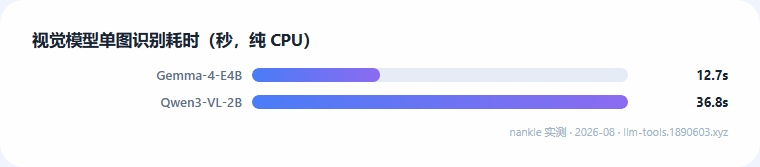
两个视觉模型单图识别耗时对比

想做本地版的「网页截图 → 按钮坐标」自动化(给 GUI Agent 用),第一步是找个能在纯 CPU 上跑的视觉模型。我选了两个最小的候选——Qwen3-VL-2BGemma-4-E4B——用真实的网页截图测了一圈:识别速度、细节质量、坐标精度。结论很有代表性:一个看得懂但给不出坐标,一个给坐标但瞄不准

环境:llama.cpp mtmd 多模态,纯 CPU,Q4_K_M 量化,temperature=0/0.3,真实网页截图 6 张。2026-08-24 实测。

速度:Gemma 快 2.9 倍

单张截图平均端到端耗时(秒,纯 CPU)
Gemma-4-E4B12.7s
Qwen3-VL-2B36.8s

差距的根源在视觉编码的 image token 数量:Gemma 每图只产生约 292 个 image token,Qwen3-VL 是 1018~1789 个(图表类图片更夸张),prefill 成本差 3~6 倍。两者文本 decode 速度其实相近——慢在「看」,不在「说」

质量 v1:各有硬伤

能力Qwen3-VL-2BGemma-4-E4B
细节识别准确:能读出「登录领取限时福利」「致态 TiPlus9100 ¥2088.51」等真实文字,几乎无幻觉幻觉明显:「京东」认成「京商」,编造不存在的「全品类/服饰/家居」导航
按钮坐标不输出像素坐标,只给「左上角/右上角」定性描述输出 (x,y,w,h),但自述「基于网页惯例的估计」,漏掉中央登录弹窗等关键按钮

典型的互补型缺陷:Qwen 是「看得懂说不清」,Gemma 是「敢说但说错」。

质量 v2:提示词优化能救多少

我改了四件事:① 强制 JSON 数组输出;② 在提示词里注入图片真实像素尺寸;③ 要求 bbox 紧贴元素边界;④ 每元素只出现一次。并用 glm-4v 做第三方参照。

  • Qwen3-VL 改善明显:注入真实尺寸后开始给出合理的坐标区间,大按钮(登录/关闭)可用,小文字按钮仍偏移
  • Gemma 依旧幻觉:坐标给得更大胆但更不准,仍会漏检弹窗
  • 最大教训VLM 不确定图片的真实像素尺寸——把「图片是 1440×1000」写进提示词是坐标任务的关键一步,很多教程没提

复现方法

想自己跑一遍的折腾党,关键配置都在这:

  • 模型下载:HuggingFace 直连超时的话用 hf-mirror.com 镜像(实测 51 MiB/s vs 直连 60 KiB/s)。Qwen3-VL-2B:主文件 1.11GB + mmproj 0.82GB;Gemma-4-E4B:主文件 4.98GB + mmproj 0.99GB——多模态模型必须带 mmproj 文件,那是视觉编码器
  • 启动命令llama-server -m 模型.gguf --mmproj 视觉.gguf -c 8192 --host 127.0.0.1 --port 端口;Gemma 必须加 --reasoning off(默认 thinking 会吃掉 token 预算且不输出可见文字)
  • 采样:temperature=0 稳定输出;Qwen 出现重复坍塌时调到 0.3
  • 两个坑:脚本里用 --port 不能用 -p(会被当成 prompt);PowerShell .ps1 含中文需 BOM 编码,否则提示词乱码——测试提示词建议统一用英文
  • 图片解码:PNG 走内置 stb 解码零依赖;JPEG 需要 ffprobe.exe 在 PATH 里

给 GUI Agent 实践者的建议

  • 速度优先 / 简单页面:Gemma-4-E4B(12.7s/图),但必须配坐标校验(元素文本匹配 + 边界外剔除)
  • 精度优先 / 文字密集页面:Qwen3-VL-2B + 尺寸注入提示词,接受 3 倍耗时
  • 工程兜底:VLM 输出坐标后,用 DOM/DOM-less 方案(如图像模板匹配)二次校准;纯 VLM 坐标直接点击在生产上还不可靠
  • 本地图快:JPEG 解码需要 ffprobe 在 PATH;PNG 走内置 stb 解码无依赖

2B 级别模型的天花板就在这了;要真正可用的坐标精度,得看 7B+ 的专用 GUI 模型(如 UI-TARS),那是另一篇的题材。推理速度的原理看纯 CPU 推理实测

免责声明:两模型均为 Q4 量化 + 纯 CPU 环境,坐标精度结论不适用于原生高精度定位模型;测试样本有限。

Building a local "screenshot → button coordinates" pipeline for GUI agents starts with a VLM that runs on CPU. I tested the two smallest candidates — Qwen3-VL-2B and Gemma-4-E4B — on real web screenshots for speed, detail quality and coordinate accuracy. They fail in perfectly complementary ways: one understands but can't give coordinates; the other gives coordinates that miss.

Setup: llama.cpp mtmd, CPU-only, Q4_K_M, real screenshots ×6. Tested 2026-08-24.

Speed: Gemma is 2.9× faster

Gemma averages 12.7s per image vs Qwen's 36.8s. Root cause: image token count — Gemma encodes ~292 tokens per image while Qwen3-VL uses 1018–1789 (charts go higher), making prefill 3–6× more expensive. Decode speeds are similar: the cost is in "looking", not "speaking".

Quality round 1

  • Qwen3-VL: accurate reading (real texts like "Login for limited-time rewards", "SSD ¥2088.51"), almost no hallucination — but refuses to output pixel coordinates, only qualitative positions
  • Gemma-4-E4B: outputs (x,y,w,h) boxes but admits they're "web-convention estimates"; misreads "JD" as another brand, invents nav categories that don't exist, and misses the central login dialog entirely

Quality round 2: prompt fixes

  • Forced JSON array output; injected true pixel dimensions into the prompt; tight bbox requirement; dedupe
  • Qwen improved meaningfully — plausible coordinates for large buttons once it knows the real resolution
  • Gemma still hallucinates and misses dialogs
  • Biggest lesson: VLMs don't know an image's true pixel size — stating "the image is 1440×1000" in the prompt is essential for coordinate tasks

Advice for GUI-agent builders

  • Speed-first / simple pages: Gemma + coordinate validation (element text matching, bounds rejection)
  • Precision-first / text-dense pages: Qwen3-VL with size-injected prompts, accept 3× latency
  • Always re-calibrate VLM coordinates with template matching before clicking — raw VLM coordinates aren't production-reliable at 2B scale
Disclaimer: both models Q4-quantized on CPU; coordinate conclusions don't apply to native high-precision GUI models (e.g. UI-TARS).
返回文章列表